How Many Hours a Day Should You Actually Study for Kharidar?
There's no magic number of study hours for Kharidar. Session structure and consistency beat marathon cramming — here's what actually works.
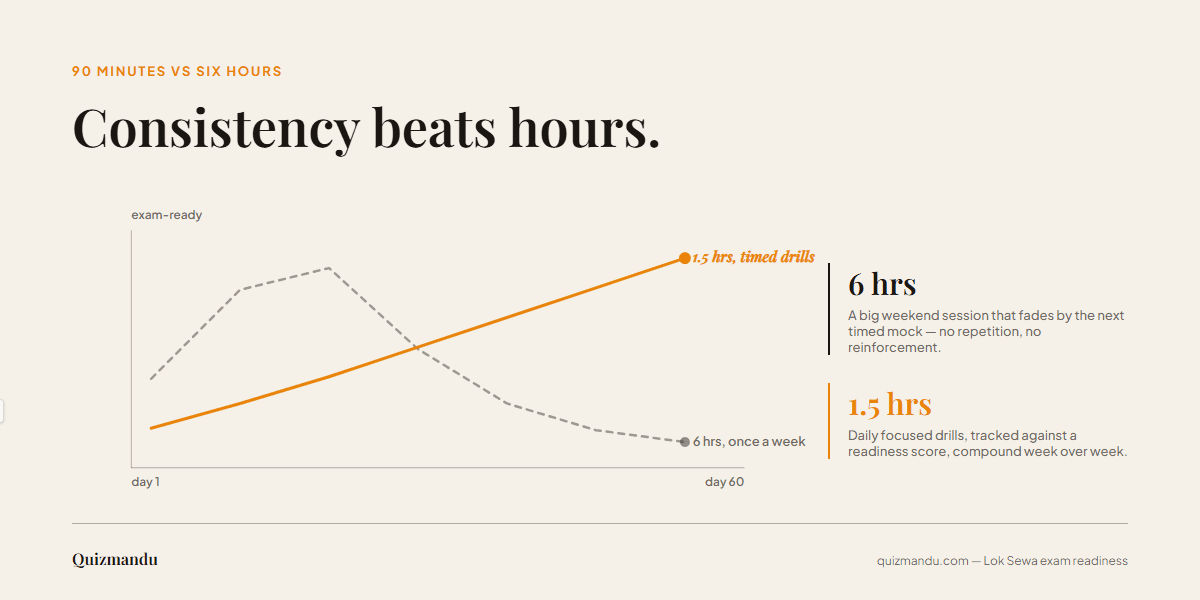
There's no fixed number of hours that guarantees a Kharidar pass. What matters is session structure, not marathon length — two focused 20-minute sessions a day, sustained for months, beat one exhausted 6-hour cram session most candidates can't actually keep up.
If you've been chasing a "12 hours a day" number you saw on a forum, here's why that number is the wrong target.
The "12 Hours a Day" Myth
Long single-block study sessions feel productive because they're exhausting — exhaustion gets mistaken for progress. In reality, focus drops sharply after the first hour or two of any single session, and everything absorbed after that point is retained poorly.
Worse, a schedule built around marathon sessions is fragile. Miss one day — a job commitment, a family event, being tired — and the whole plan collapses, because there was no smaller, repeatable unit to fall back on.
What Actually Works: Short, Repeated, Spaced
Spaced repetition — reviewing material in short sessions spread across days, rather than once in a long block — is a well-established way to make information stick. The mechanism is simple: your brain treats information you're forced to recall again after a gap as more important than information seen once and set aside.
| Approach | Retention over time | Sustainable daily? | Best for |
|---|---|---|---|
| One long session (4-6+ hrs) | Drops off quickly after day 1 | Rarely — burns out fast | Cramming right before a mock |
| Short focused sessions (15-20 min, multiple times daily) | Holds up over weeks | Yes — fits around a job or classes | Building long-term recall |
This is also the logic behind Quizmandu's Quick Drill mode — sessions built to run 15 to 20 minutes, so a working candidate can fit real practice into a lunch break instead of needing a free evening.
A Realistic Daily Structure
Instead of asking "how many hours," ask "how many focused blocks can I actually repeat every day without fail." A workable structure for most Kharidar candidates looks like:
- Morning (15-20 min): One quick drill — General Knowledge or IT, rotating daily
- Midday or commute (15-20 min): Nepali or English practice — short comprehension or grammar sets
- Evening (20-30 min): Office Management & Accounting, or a timed practice set
- Weekly: One full mock exam to check your readiness trend, not just that day's topic
That's roughly an hour a day, done consistently, structured around recall rather than re-reading. It will outperform an inconsistent 4-hour plan almost every time, because consistency is what spaced repetition actually depends on.
Fit Real Practice Into a Real Schedule
If your current plan depends on finding large blocks of free time you don't reliably have, it's not a plan you'll finish. Quizmandu's Quick Drill and Timed modes are built around the same 15-20 minute session length that actually holds up against a job, classes, or family responsibilities — so consistency, not hour count, becomes your advantage.