What a Readiness Score Actually Predicts About Your Exam Result
A readiness score tracks whether your mock performance is trending toward the 65% selection zone — here's what it actually measures, and what it doesn't.
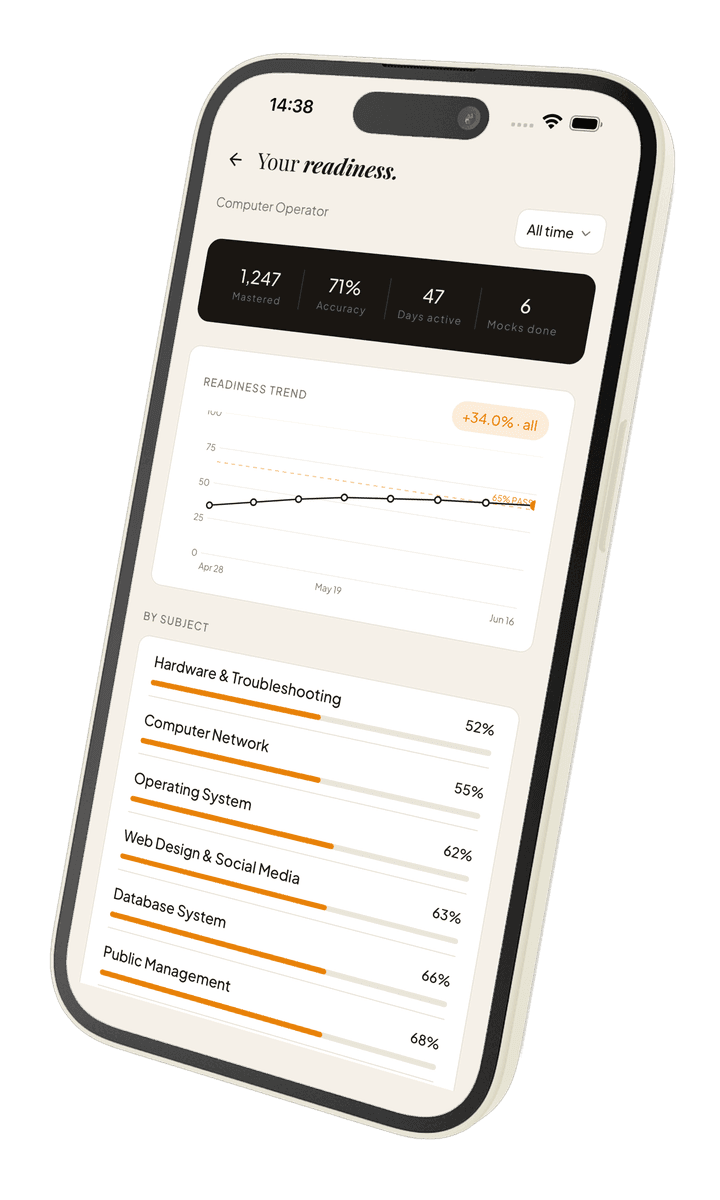
A readiness score is a percentage based on your recent mock exam performance, tracking whether you're trending toward the 60–75% range where selections actually happen. It matters because "I finished the syllabus" tells you nothing about how you'll perform under time pressure — a readiness score does.
Here's what it actually captures, what it doesn't, and why it beats the way most candidates currently judge their own prep.
"Finished the Syllabus" Is Not a Measurement
Most candidates track prep by coverage: which chapters they've read, how many notes they've made. Coverage tells you what you were exposed to. It says nothing about what you can still recall, under a clock, three months later.
A readiness score works differently. It's built from actual mock performance — not what you read, but what you got right when it counted, recently. That's a meaningful shift: from "did I study this" to "can I still perform on this."
The word "recently" matters as much as the word "score." A candidate who scored well two months ago but hasn't practiced since isn't necessarily still at that level — recall fades without repetition. A score that updates weekly is measuring where you actually stand today, not where you stood at your best moment.
A Hypothetical Walk-Through
Say a candidate starts mock testing eight weeks before their exam. Their first mock score sits at 48% — solidly in the qualifying zone, nowhere near selection territory. Over the following weeks, as weak topics get identified and drilled specifically, their scores climb.
| Week | Mock score | Zone |
|---|---|---|
| 1 | 48% | Qualifying |
| 3 | 55% | Qualifying |
| 5 | 61% | Approaching selection |
| 7 | 67% | Selection zone |
By week 7, this candidate isn't guessing whether they're ready — the trend line shows it. This is illustrative, not a guarantee: real progress speed depends on the candidate, the exam, and how consistently they practice. But the pattern — tracking a trend instead of a single score — is the actual value.
What a Readiness Score Doesn't Predict
Be clear-eyed about the limits here. A readiness score is not a promise of selection. It doesn't account for:
- Interview performance — most Lok Sewa posts include an interview stage the score doesn't touch.
- Exam-day conditions — nerves, unfamiliar question phrasing, and time pressure on the actual day are not fully replicated by any mock.
- Syllabus or format changes — if the PSC updates a syllabus mid-cycle, your historical trend needs to reset against the new material.
A readiness score tells you one thing reliably: whether your preparation, measured honestly and recently, is closing the gap to where selections happen. That's already more than most candidates know about their own prep.
It's also not a substitute for judgment. If your score climbs steadily but you know you guessed your way through a section, treat that section as still weak — the score reflects what you answered, not how confidently you knew it.
Track Your Trend, Not Just Your Score
Checking your score once and calling it done misses the point — the value is in watching the line move. Quizmandu's weekly readiness score recalculates after every mock, so you always know whether this week's prep moved you closer to the 65% mark, not just whether you passed one test.