Common Reasons Lok Sewa Candidates Fail Despite Studying Hard
Most Lok Sewa candidates fail not from lack of effort, but from four repeatable mistakes — no weak-topic tracking, GK overfocus, and no timed practice.
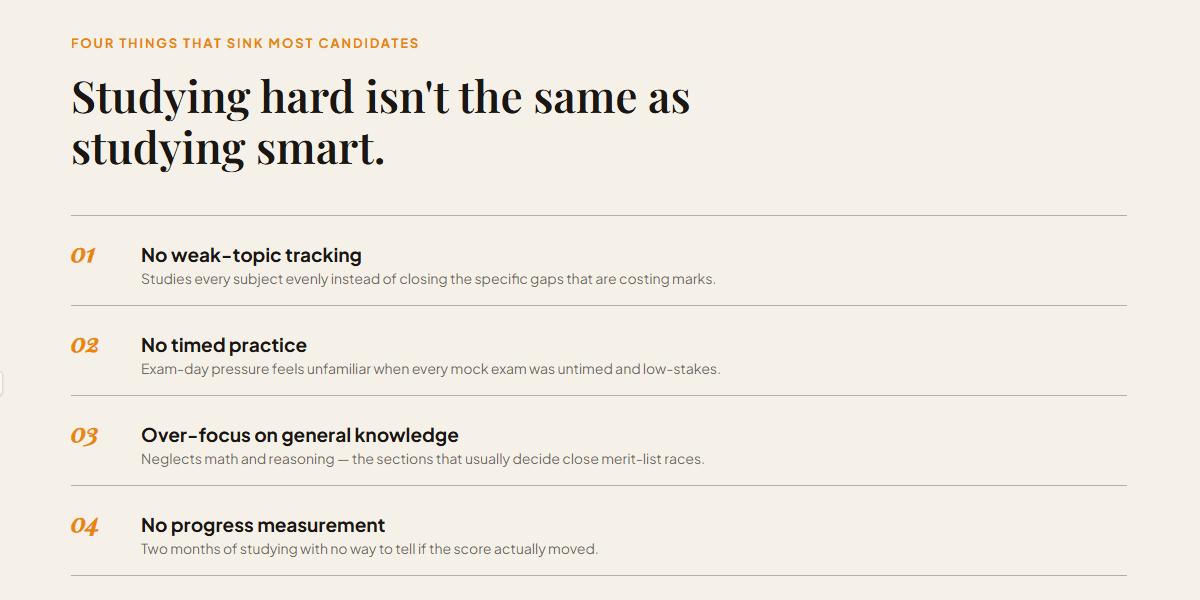
Most candidates fail not because they didn't study enough, but because they never tracked what they were weak in. Effort and result aren't the same thing — and four specific patterns explain most of the gap between candidates who study hard and candidates who actually get selected.
1. No Weak-Topic Tracking
Studying everything equally feels thorough. It isn't efficient. If you're spending the same hours on a subject you already score 80% in as one you score 40% in, you're wasting half your study time reinforcing strength instead of fixing weakness.
The fix isn't "study harder" — it's knowing, specifically, which topic is costing you marks right now, and putting your next session there.
2. Over-Focusing on GK, Neglecting Math and Reasoning
General Knowledge feels approachable — current affairs, geography, history — so candidates gravitate to it. Math and reasoning feel harder, so they get avoided. But reasoning and numerical sections are often where the biggest score swings happen, precisely because most candidates under-practice them.
If you can recite a dozen recent current-affairs facts but freeze on a percentage or ratio question, that imbalance is a study-plan problem, not a talent problem.
3. No Timed Practice Before Exam Day
Reading a chapter and solving an untimed question set tells you what you know. It does not tell you what you can produce in 90 seconds with the clock visible and the room full of other candidates. Timed pressure changes performance — often significantly — and the only way to prepare for that is to practice under it, repeatedly, before exam day.
Candidates who skip timed mocks are often surprised by how much slower and more error-prone they are under real conditions. That surprise should happen in practice, not on exam day.
4. Studying Without Measuring Progress
| Failure pattern | Why it happens | What actually fixes it |
|---|---|---|
| No weak-topic tracking | Studying by "what feels productive," not by data | Review a topic-level breakdown after every mock |
| GK overfocus | Easier subjects feel more rewarding to study | Deliberately schedule math/reasoning time, even when it's uncomfortable |
| No timed practice | Untimed study feels less stressful | Take full mocks under real time limits, regularly, not just once |
| No progress measurement | No clear number to check against | Track a score trend weekly, not just pass/fail on one test |
Without a number to check against, weeks of study can pass without any real signal on whether you're improving. Candidates in this position often don't realize they've plateaued until it's too late to fix.
Fix the Pattern, Not Just the Effort
All four of these are measurement problems, not motivation problems. Quizmandu's mock exams and weekly readiness score exist specifically to close this gap — after every mock, the weakness breakdown shows exactly which topics are dragging your score down, so your next session fixes the right thing instead of the comfortable thing. See how it works.