Kharidar Syllabus & Exam Pattern 2083 (Lok Sewa)
Kharidar exam pattern 2083: 3 stages, 240 marks, Stage I pass mark 45. See every syllabus unit, Paper II and III topics, and the computer test.
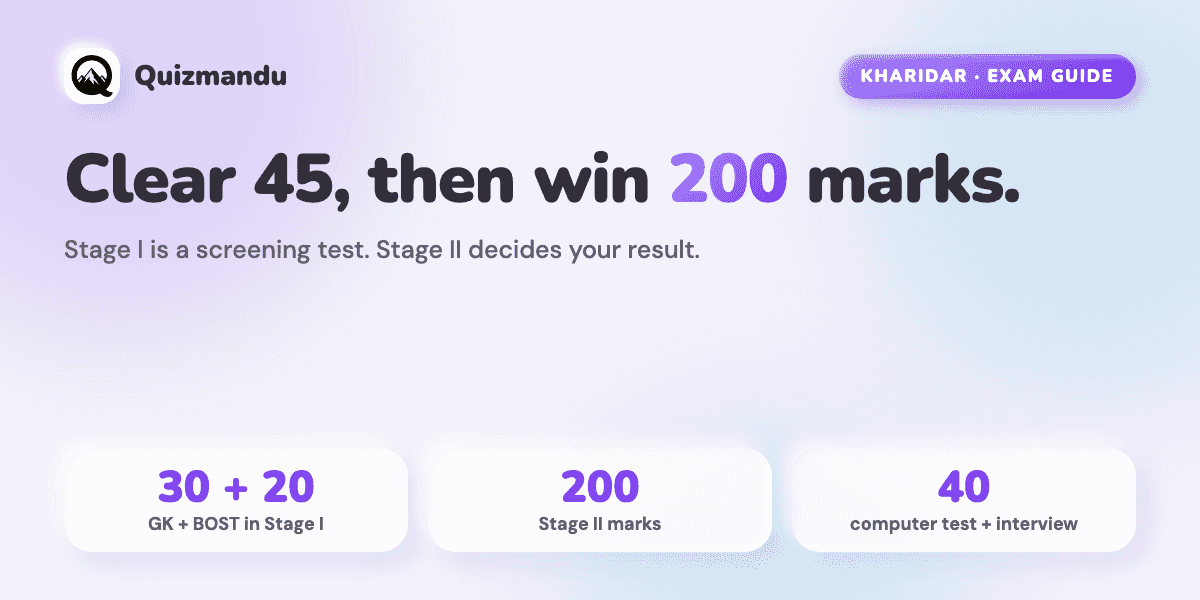
The Kharidar exam under Lok Sewa Aayog has 3 stages and 240 final marks. Stage I is a 100-mark MCQ screening test with a pass mark of 45. Stage II is two written papers of 100 marks each. The final stage is a 10-mark computer skill test and a 30-mark interview.
This guide explains each stage in simple English. It uses the official PSC syllabus, so you can see what to study and how the marks are divided.
Kharidar Exam Pattern: Quick Facts
| Item | Detail |
|---|---|
| Post | Kharidar, Non-Gazetted Second Class (राजपत्र अनंकित द्वितीय श्रेणी) |
| Minimum education | +2 / Intermediate or equivalent |
| Age | 18 to 35 years (18 to 40 for women and persons with disabilities) |
| Total stages | 3 |
| Final result | 240 marks (Stage II 200 + Final Stage 40) |
| Stage I | 100 marks, pass 45, screening only |
| Stage II | 200 marks, minimum 40 in each paper |
| Final Stage | Computer Skill Test 10 + Interview 30 |
| Negative marking | Stage I only: −0.4 per wrong answer |
For the full exam page, see the Kharidar exam page.
Stage I: Preliminary MCQ Test (100 Marks)
Stage I has 50 questions of 2 marks each. You get 45 minutes. You need 45 out of 100 to move to Stage II.
Stage I is a screening test. Its marks are not added to your final 240 marks. You only need to clear 45 safely.
Each wrong answer loses 0.4 marks (20% of the question). Unanswered questions lose nothing. Learn the math in our guide to negative marking in Lok Sewa.
Section A: General Knowledge (30 Questions, 60 Marks)
| Unit | Topic | Questions |
|---|---|---|
| 1 | Solar System and Geography | 6 |
| 2 | History | 6 |
| 3 | Nepal's Social, Economic Condition and Governance | 6 |
| 4 | Science, Technology, Public Health and Environment | 6 |
| 5 | International Relations and Current Affairs | 6 |
| Total | 30 |
Every unit has 6 questions, so no unit is safe to skip. What each unit covers:
- Solar System and Geography: the solar system and Earth, continents, oceans, latitude and longitude, time, mountains, rivers, climate, and Nepal's location, relief features and natural resources.
- History: the Industrial Revolution, French Revolution, American War of Independence, World Wars, the Kiranti, Lichhavi and Malla periods, and modern Nepal.
- Social, Economic Condition and Governance: traditions, religions, languages, cultural heritage, economic growth, GDP, remittance, agriculture, industry, tourism and governance.
- Science, Health and Environment: scientific inventions, health, food and nutrition, biodiversity, climate change, pollution, population and migration.
- International Relations and Current Affairs: the United Nations, SAARC, ASEAN, the EU, national and international current affairs, and noted personalities.
Section B: Basic Office Skills Test, BOST (20 Questions, 40 Marks)
BOST is set at about Class X level. It tests logical thinking and speed, not memory. The syllabus lists 10 question types. It does not say how many of the 20 questions come from each type, so practice all of them:
| Type | What you do |
|---|---|
| Verification | Find errors, similarities or differences in data, numbers or words |
| Completion | Complete a series, pattern or matrix |
| Classification | Find the odd one out |
| Analogy | Find the relationship (words, numbers or pictures) |
| Filing Aptitude | Sort items alphabetically, by number or by date |
| Follow Instructions | Solve a problem by following written steps exactly |
| Numerical Reasoning | Basic arithmetic |
| Coding and Matching | Encode or decode words or numbers |
| Analytical Reasoning | Verbal, number or picture-based reasoning |
| Direction and Distance | Work out direction and distance from a described path |
Many candidates are caught off guard by BOST because it needs pattern-spotting speed. Practice with a timer. No calculator is allowed.
Stage II: Main Written Exam (200 Marks)
Stage II has two subjective papers. Each is 100 marks and 2 hours 30 minutes. You must score at least 40 in each paper. A strong Paper II cannot save a failed Paper III.
These are called Paper II and Paper III because Paper I is the Stage I MCQ test. You can write in Nepali, English or both.
Paper II: Office Management
12 short questions of 5 marks and 4 long questions of 10 marks.
| Section | Marks | Main topics |
|---|---|---|
| Office Management | 40 | Office functions and types, correspondence (registration and dispatch, circulars, orders), note and report writing, record management and filing, meeting management and minutes, public relations and grievance handling |
| Constitution and Civic Awareness | 30 | Fundamental rights and duties, directive principles, constitutional bodies (CIAA, Auditor General, PSC, Election Commission, NHRC and others), human values and discipline |
| General Mathematics | 30 | Percentage, ratio, profit and loss, discount, tax and commission, simple and compound interest, averages, household bills and money exchange, length, area and volume |
General Mathematics is 30 marks of mechanical, repeatable topics. It is a good scoring chance that many candidates ignore.
Paper III: Job Knowledge
8 short questions of 5 marks and 6 long questions of 10 marks.
| Section | Marks | Main topics |
|---|---|---|
| Public Service Administration | 35 | Civil Service Act, public service delivery and Public Charter, Good Governance Act 2064, Right to Information Act 2064, Anti-Corruption Act 2059, vital registration, e-governance |
| Accounting, Procurement and Audit | 35 | Accounting system and budget, vouchers and cash book, bank reconciliation, public procurement and stores, audit, VAT, Financial Procedures and Fiscal Responsibility Act 2076 |
| Law and Justice Knowledge | 30 | Sources of law, court levels and jurisdiction, summons and written documents, complaint and arrest warrant, Muluki Civil Code and Criminal Code basics |
Accounting, Procurement and Audit is the most technical section, so start it early and practice the numerical problems.
Final Stage: Computer Skill Test and Interview (40 Marks)
| Part | Marks | Time |
|---|---|---|
| Computer Skill Test | 10 | 15 minutes, on a computer |
| Interview | 30 | Oral |
Our Kharidar exam page breaks the computer test into Devanagari typing (2.5 marks, 5 minutes), English typing (2.5 marks, 5 minutes), and Windows basics plus MS Word (5 marks, 5 minutes). Our exam page also lists a speed scale of 25 correct words per minute in Devanagari and 30 in English for full typing marks. The official syllabus PDF gives only the total marks and time, so confirm the details in the latest PSC notice.
For a task-by-task guide to a similar test, read our Computer Operator practical exam guide.
Who Can Apply
- Education: +2 / Intermediate (10+2, A-Level, PCL) or equivalent from a recognized board.
- Age: 18 to 35 years for men. 18 to 40 for women and persons with disabilities. Permanent civil servants have no upper age limit.
- How age is counted: on the last date of application in the advertisement, using the Bikram Sambat date of birth on your citizenship certificate.
- Citizenship: Nepali citizen.
If you have a Bachelor's degree, you can also look at the next level. See our Nayab Subba syllabus and exam pattern. To see what the post pays, read Lok Sewa salary 2083.
How to Spend Your Study Time
This is our suggestion, based on the marks above:
- Stage I first, but only to reach 45. Revise all five GK units and practice BOST with a timer.
- Start Stage II early. It carries all 200 marks of your final result. Answers need writing practice, so time yourself.
- Win the predictable marks. General Mathematics (30) and office management questions are the most repeatable parts of Paper II.
- Give Accounting and Law more weeks. They are technical and need dedicated practice.
- Practice typing every day for several weeks before the final stage.
Stage I marks do not count toward your final result, so a mock score tells you only whether you are safe to advance. A weekly readiness score shows which unit is holding you back.
Start free Kharidar practice →
Frequently Asked Questions
What is the Kharidar exam pattern?
The exam has 3 stages. Stage I is a 100-mark MCQ screening test. Stage II is two subjective papers of 100 marks each. The final stage is a 10-mark computer skill test and a 30-mark interview. The final result is out of 240 marks.
What is the pass mark for Kharidar Stage I?
You need 45 out of 100 in Stage I. It is a screening test, and its marks are not added to your final result.
Is there negative marking in the Kharidar exam?
Yes, in Stage I only. Each wrong answer loses 0.4 marks, which is 20% of a 2-mark question. Unanswered questions lose nothing. Stage II has no negative marking.
What is BOST in the Kharidar exam?
BOST is the Basic Office Skills Test, Section B of Stage I. It has 20 questions worth 40 marks, at about Class X level. It covers 10 question types such as verification, analogy, filing and direction and distance.
What are Paper II and Paper III in Kharidar?
They are the two subjective papers of Stage II. Paper II covers office management, the Constitution and civic awareness, and general mathematics. Paper III covers public service administration, accounting, procurement and audit, and law and justice. Each needs at least 40 marks.
How is the final Kharidar result calculated?
The final result is out of 240 marks. It adds Stage II (200 marks) and the final stage (40 marks: computer skill test 10 and interview 30). Stage I marks are not included.
What is the qualification for Kharidar?
You need +2 or Intermediate (or equivalent) from a recognized board. The age limit is 18 to 35 years for men and 18 to 40 for women and persons with disabilities.
How is Kharidar different from Nayab Subba?
Kharidar is Non-Gazetted Second Class and needs a +2. Nayab Subba is Non-Gazetted First Class and needs a Bachelor's degree. Both follow the same three-stage structure, but their papers differ.
Final Words
Kharidar has a clear pattern: clear 45 in Stage I, then win the 200 marks in Stage II, then finish strong in the computer test and interview. Know each unit, practice under time, and track your weak areas every week.
Last checked: 1 November 2026, against the official PSC Kharidar syllabus: Stage I and computer test (PDF) and Paper II and Paper III (PDF). Rules can change, so always read the latest notice at psc.gov.np. Quizmandu Lok Sewa Prep is an independent study app and is not part of Lok Sewa Aayog.